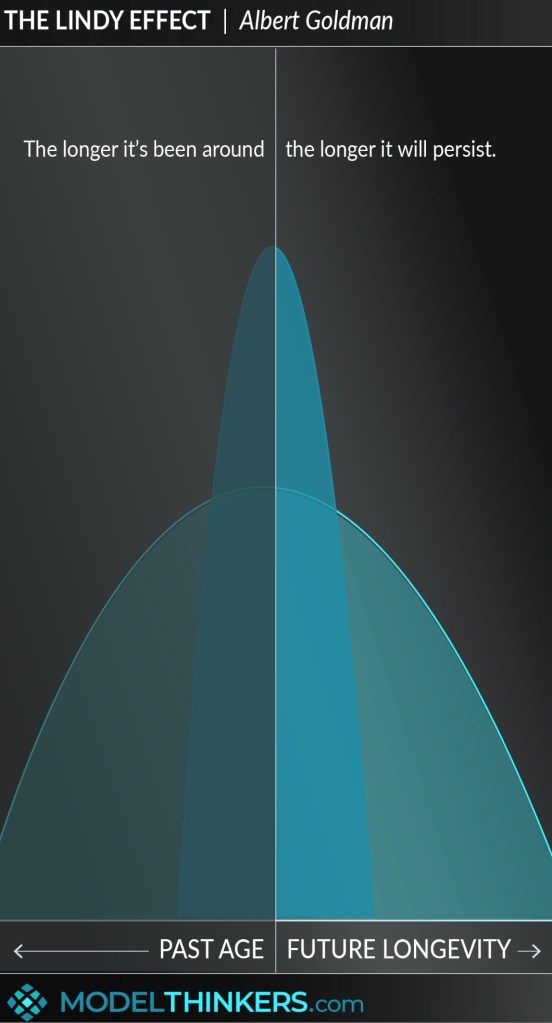
The Lindy Effect essentially states that the longer a non-perishable item has been around, the longer it’s likely to persist into the future.
The Lindy Effect was named after a New York deli and originally referenced the career prospects of comedians . The definition was since broadened so that today The Lindy Effect states that the future life expectancy of a non-perishable item is proportional to its current age. It reflects the common adage that things that have stood the ‘test of time’ are things that you can rely on.
Nassim Taleb, the author of Antifragile, captured this model well:
If a book has been in print for forty years, I can expect it to be in print for another forty years. But, and that is the main difference, if it survives another decade, then it will be expected to be in print another fifty years.
“This, simply, as a rule, tells you why things that have been around for a long time are not “ageing” like persons, but “ageing” in reverse. Every year that passes without extinction doubles the additional life expectancy. This is an indicator of some robustness. The robustness of an item is proportional to its life!”
 Majicman Notes
Leave a comment