When trying to change minds, organizations or even the world, we often default to a particular approach: pushing. Boss not listening to that new idea? Send them another PowerPoint deck. Client isn’t buying the pitch? Remind them of all the benefits.
The intuition behind this approach comes from physics. If you’re trying to move a chair, for example, pushing usually works. Push it in one direction and it tends to go that way. Unfortunately, people and organizations aren’t like chairs; they often push back. Instead, it helps to look to chemistry, where there’s a proven way to make change happen fast: Add a catalyst.
Catalysts convert air into fertilizer and petroleum into bike helmets. But most intriguing is the way they generate change. Instead of adding heat or pressure, they provide an alternate route, reducing the amount of energy required for reactions to occur. Rather than pushing, they remove barriers.
Instead of giving people more facts, figures or reasons, smart change agents find the hidden obstacles preventing change and mitigate them. Instead of asking what might convince someone to change, catalysts start with more basic questions: Why haven’t they changed already? What’s stopping them?
There are five recurring barriers to change.
Reduce reactance.
People like to feel like they’re in control—in the drivers’ seat. When we try to get them to do something, they feel disempowered. Rather than feeling like they made the choice, they feel like we made it for them. So they say no or do something else, even when they might have originally been happy to go along. Psychologists call this negative response “reactance.”
Allow for agency. Guide the path but make sure people feel like they’re still in control. Smart consultants do this when presenting work to clients. If you share just one solution, the clients spend the meeting trying to poke holes in it. To shift this mind-set, good presenters often share multiple options. That way, rather than focusing on flaws, the clients focus on which option they prefer, which makes them much more likely to support moving forward.
Another way to reduce reactance is to highlight a gap between someone’s thoughts and actions, or between what they would recommend to others and what they themselves are doing.Highlighting such dissonance encourages people to try to resolve it.
Ease endowment.
Research on everything from investment choices to political incumbency demonstrates that people are over-attached to the status quo, what social scientists call the “endow-ment effect.” We tend to stick with things we know and have used for a long time. Part of the challenge is that the status quo usually isn’t that bad, or else people would have made a change.
Change agents combat this phenomenon by bringing the costs of inaction to the surface, helping people to realize that sticking with the status quo isn’t as cost-free as it seems.
Shrink distance.
When new information comes in, people tend to compare it to their existing views to see if it is a close enough match to consider. Psychological experi-ments have found a “zone of acceptance,” an area close enough to people’s existing beliefs that they’ll consider new information. Incoming content that is too far away from their current perspective falls into a region of rejection and gets discounted. Product designers talk about such gradual shifts in behavior as stepping stones—a way to make a big shift feel less daunting. Uber’s initial model didn’t depend on persuading people to take a ride in a random stranger’s car. That’s exactly what Mom told you not to do. The company started instead by making high-end black-car service more accessiable.
Alleviate uncertainty.
Change usually involves some level of risk. Will a new product be better than the old one? Will a new initiative really save money? Research published by thE University of Chicago researchers found that there is an “uncertainty tax.” People in the study were willing to pay $26 for a $50 gift certificate, but when they were asked how much they’d pay for a lottery ticket that would win them either that same $50 gift card or a $100 one, they were only willing to pay $16, a 40% drop. The uncertainty made them undervalue something that was objectively worth more. To ease uncertainty, lower the barrier to trial. Don’t just tell people that something is better; allow them to experience it themselves. People didn’t understand cloud storage and worried that it would be difficult to use or that they would lose their work. So Dropbox started giving away a version of their service for free. The appetizer helped people to resolve their uncertainty and encouraged them to pay to upgrade to a better version. Uncertainty can also be reduced by making things re-versible. You can offer a trial period.” The trial didn’t reduce the upfront costs, but it did remove the uncertainty.
Find corroborating evidence.
For big changes, sometimes hearing from one person isn’t enough. You can follow up multiple times with new information, but the listener is still faced with a translation problem. Sure, you think something is the right course of action, but you’re just one person. How do they know what you’re saying is right? There’s strength in numbers. That’s why substance-abuse counselors use group interventions to drive action. Corporate boards wait to adopt new practices until they’ve been adopted by several peer institu-tions. Doctors wait to adopt new drugs until multiple colleagues start using them. that the incidence of people As the adage goes, “if one person says you have a tail, you laugh and think they’re crazy. But if three people say it, you turn around to look.”
Whether you’re trying to convince a client, change an organization, disrupt a whole industry or just get someone to adopt a puppy, the same rules apply. It’s not about pushing harder or exerting more energy. It’s about reducing barriers to action. Once you understand that, you can change anything.
Dr. Jonah Berger
Marketing professor at the Wharton School
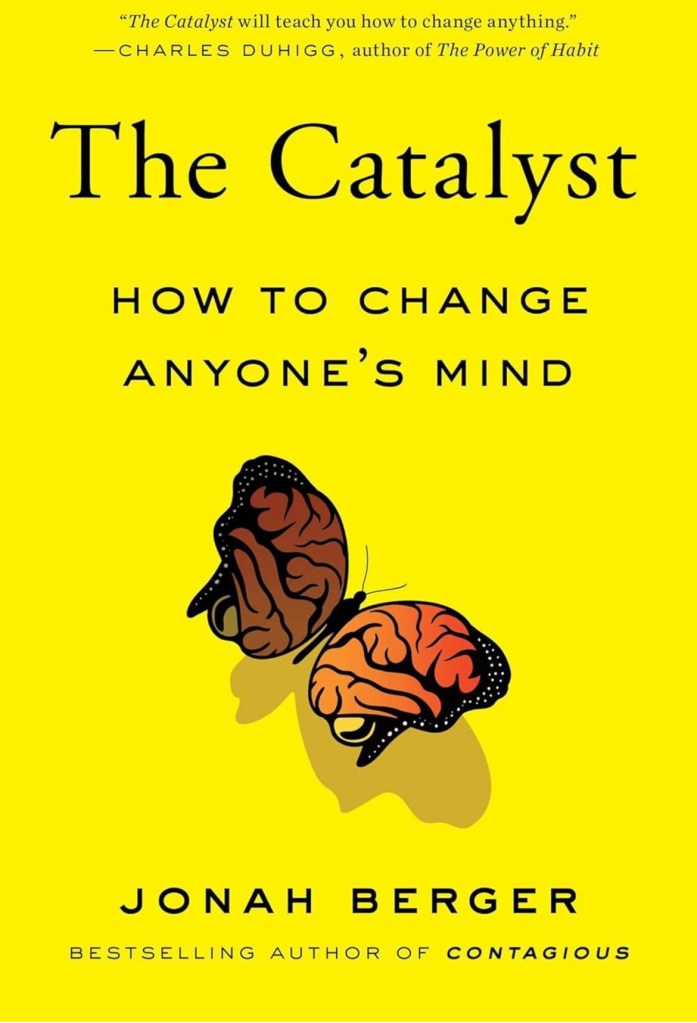
The Catalyst: How to Change Anyone’s Mind
 Majicman Notes
Leave a comment